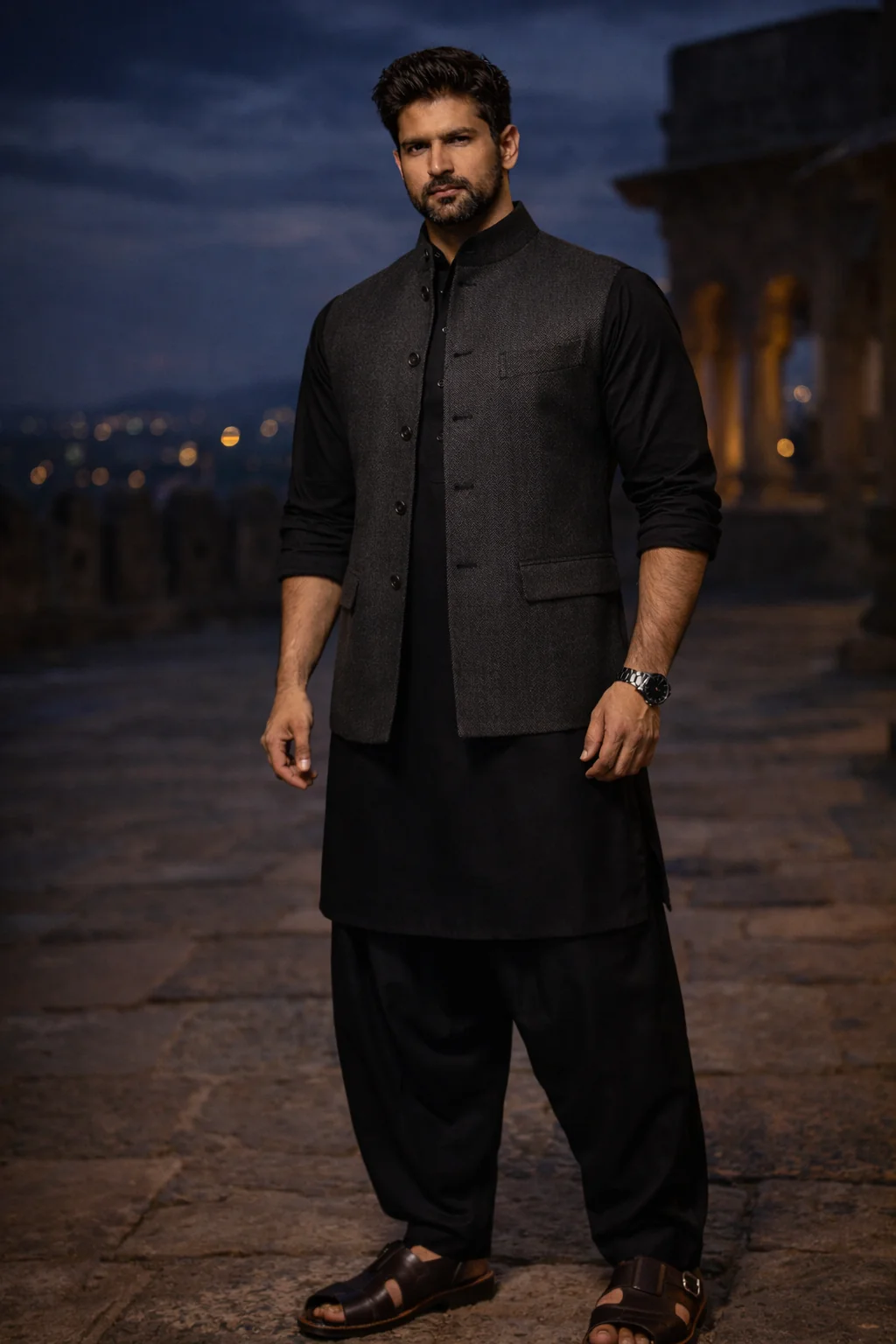
Pathani suit is not Just a kurta, it’s a uniform. A perfectly crafted Pathani suit with a Sadri and a pair of Peshawari chappal is the ultimate outfit for any event.
You have bought the authentic Pathani Suit. The collar is crisp, the shoulder flaps are buttoned, and the salwar falls perfectly. But when you look in the mirror, something is missing. You look good, but you don’t look complete.
A Pathani suit is a powerful garment, but it is also a “blank canvas.” Because of its solid color and loose structure, styling it wrong can make you look like you are wearing a night-suit. Styling it right, however, makes you look like a leader.
The difference between looking “casual” and looking “commanding” lies in the layers you add. Whether you call it a Nehru Jacket, a Modi Jacket, or by its traditional name—the Sadri—the third piece is what builds your Rutba (presence).
Here is the ultimate guide on what to wear with your Pathani suit to take it from “Simple” to “Significant.”
1. The Power Layer: The Nehru Jacket (Sadri)
The loose silhouette of a Pathani is designed for comfort, but sometimes, you need structure. This is where the Nehru Jacket comes in.
In the rugged terrain of Kabul and Peshawar where the Pathani originated, this sleeveless vest is known as a Sadri or Waskat. It is not just an accessory; it is essential engineering. It holds the loose fabric of the kurta in place, broadens your chest, and gives you a sharper, V-shaped torso.
How to Choose the Right Jacket
Many men make the mistake of wearing a shiny, silk wedding jacket with a rugged cotton Pathani. This is a clash of identities.
- Fabric Matters: A Pathani is a masculine, utility-based outfit. Your jacket should match that energy. Choose Matte Fabrics like Khadi, Tweed, Jute, or heavy Cotton. Avoid shiny satin or “Art Silk” unless you are the groom.
- The Fit: Unlike a tuxedo waistcoat which is cut tight, a Sadri for a Pathani should be cut slightly boxy. It needs to sit comfortably over the layers of the kurta without bunching up.
- The Button Rule: Never button it all the way down. Leave the top button open for a relaxed look, or button it up fully only for formal events. Always leave the bottom button open to allow for easy sitting (traditionally on the floor or low seating).
Style Combo:
- The “Leader” Look: Black Pathani + Grey Tweed Nehru Jacket.
- The “Daytime” Look: White Pathani + Beige/Khaki Cotton Jacket.
2. The Foundation: Peshawari Chappals
Shoes can make or break an outfit. If you wear sports shoes or formal oxfords with a Pathani, you immediately kill the vibe.
The Pathani has a wide leg (the salwar). A wide leg needs a “heavy” shoe to balance it visually.
- The Only Choice: The Peshawari Chappal. With its thick sole, broad leather straps, and back-buckle, it is the historical brother of the Pathani suit. It adds weight to your feet, grounding your walk.
- The Alternative: If you must wear a closed shoe (perhaps for office or winter), choose a broad Loafer or a Mojari with a rounded toe.
- The “Big No”: Avoid pointed styling shoes (Khussas) that curl at the toe. They are too delicate and decorative for the rugged structure of a Pathani.
3. The Wrist Game: Analog Power
Because a Pathani usually has folded or buttoned cuffs, your wrists are visible. This is prime real estate for styling.
- Analog Only: A Pathani is old-school. Your watch should be too. A digital smartwatch (like an Apple Watch) looks too “tech” and corporate against the traditional fabric.
- The Recommendation: Wear a chunky Analog Watch with a steel or leather strap. It matches the “Field Marshal” aesthetic of the shoulder flaps.
- Rings: A single silver or stone ring adds to the traditional aesthetic without looking flashy.
4. Winter Styling: The “Loi” (Shawl)
In winter, do not cover your Pathani with a denim jacket or a hoodie. It looks confused. Instead, embrace the Loi (Mens Shawl).
- The Look: Drape a Pashmina or a heavy wool shawl over one shoulder (the “Zamindar” drape).
- Why it works: It adds royalty to the outfit. It keeps you warm while letting the collar and front placket of the Pathani remain visible.
Summary Checklist: The “Rutba” Test
Before you step out, do a quick check:
- Collar: Is it stiff and standing, not flat?
- Layer: Are you wearing a matte Nehru Jacket (Sadri) to add structure?
- Feet: Are you wearing Peshawari Chappals or heavy loafers?
- Wrist: Is that smartwatch swapped for a classic analog?
If you checked all four, you aren’t just wearing clothes. You are wearing a legacy.